The Coral Triangle

Map of the Coral Triangle.

The Coral Triangle, located in the western Pacific Ocean, encompasses the waters of Indonesia, Malaysia, the Philippines, Papua New Guinea, Timor Leste, and the Solomon Islands. It is known for having the world’s highest biodiversity of coral and fish species, with over 600 species of coral and over 3,000 species of fish. The region is considered to be a global center of marine biodiversity and is of significant importance for both marine ecosystems and the local communities that rely on the resources provided by the ocean for their food, income, and protection from storms.

However, the coral reefs in the region are facing significant threats such as overfishing, pollution, and climate change, which are causing declines in the health of the coral reefs and reducing the biodiversity they support. In order to protect and preserve the unique biodiversity of the region, as well as the livelihoods and cultural heritage of local communities, conservation efforts are needed.

Some of the key conservation efforts underway in the Coral Triangle include the creation of Marine Protected Areas, promotion of sustainable fishing practices, implementation of climate change adaptation measures, and the implementation of community-based management approaches. These efforts are aimed at ensuring the long-term health of the coral reefs and the biodiversity they support, and preserving the resources that are critical to the livelihoods and well-being of the local communities.
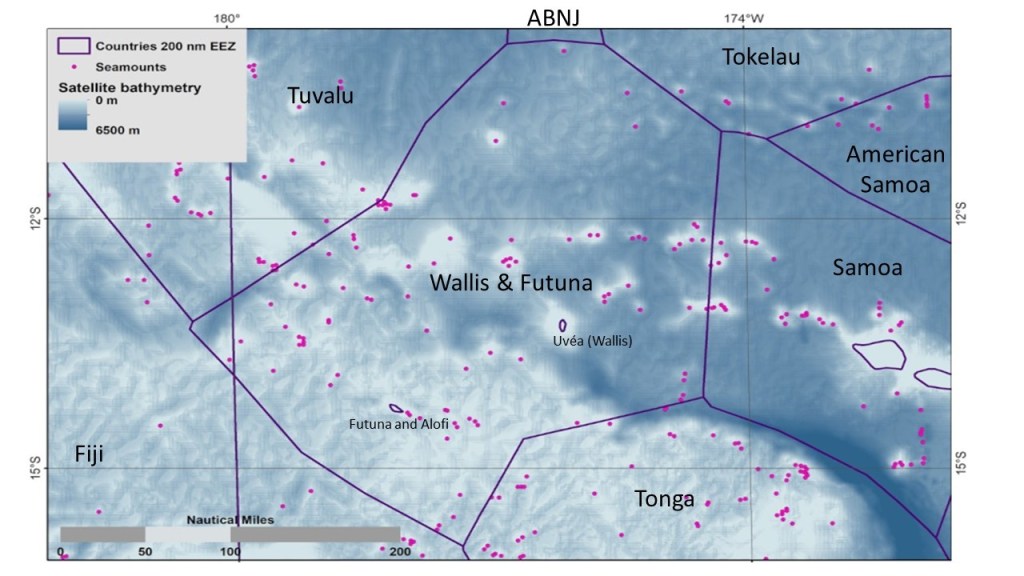
50-year moratorium on deep sea mining in Wallis & Futuna

Map of Wallis & Futuna. © Conservation International

Recognizing the bold commitment made by the Territorial Assembly of French territory Wallis et Futuna (led by President David Vergé) who passed a bill calling for France to conserve 100% of their maritime zone (265,000 square km) as a protected area for sustainable natural resource management. The move also called for the establishment of a 50-year moratorium on deep-sea mining. Most of the territory’s marine realm is formally classified as Ecologically and Biologically Significant under the Convention on Biological Diversity (CBD), featuring a wide range of charismatic species.

Discovering the Lau Seascape

A white-tipped reef shark swims between the coral in Lau Seascape.
Photo by Conservation International.

I visited Fiji this week, went to Lau Seascape – covers an area of roughly 114,000 square km. This area is threatened by climate change, unsustainable fishing, and coral reefs degradation. Managing this area will be crucial for ensuring its resilience to climate change and ensuring its services to provide food and livelihoods for thousand people.

In 2017, CI team conducted a Rapid Assessment Program (RAP) in Lau Seascape to highlighted areas of significant biodiversity that requires protection, as well as areas that have been over exploited and requires supportive management. The expedition discovered six new species and supported the establishment of Navatu Reef Marine Protected Area (MPA). Here is CI’s video about Lau Seascape.

Mt. Panie New Caledonia, the largest cloud forest in the Pacific

Mount Panie in New Caledonia. Photo by Conservation International.

I went to New Caledonia this week to see Mt. Panie reserves and other Conservation International’s initiatives in the country. The mountain is the highest mountain in New Caledonia (1,629 m), providing ecosystem and cultural services, home to three-quarter of plant species, and 95% reptile species are found nowhere else!

Our team has been working to conserve the Mt. Panie since 1996 and now supporting the expansion from 5,400 ha to 20,000 ha, to enabling this critical ecosystem to mitigate climate change impact. This forest also important to the continued flow of pristine rivers and the conservation of the downstream mangroves, coral reef and lagoons with its manta rays, turtles and whales.

Coral reefs in Upolu Samoa

Samoa, Apia, Sinalei Reef Resort-
Samoa, Apia. Photo by Traveller.com.au

National Geographic published a video of the recent study by a team of researchers in Upolu island of Samoa. They concluded that the combination of climate change and human activity has led to intense die-offs around the Samoan island of Upolu.

Here is the abstract:

Coral reef ecosystems worldwide are immediately threatened by the impacts of climate change. Here we report on the condition of coral reefs over 83 km of coastline at the island of Upolu, Samoa in the remote South West Pacific in 2016 during the Tara Pacific Expedition. Despite the distance to large urban centers, coral cover was extremely low (<1%) at approximately half of the sites and below 10% at 78% of sites. Two reef fish species, Acanthurus triostegus and Zanclus cornutus, were 10% smaller at Upolu than at neighboring islands. Importantly, coral cover was higher within marine protected areas, indicating that local management action remains a useful tool to support the resilience of local reef ecosystems to anthropogenic impacts. This study may be interpreted as cautionary sign for reef ecosystem health in remote locations on this planet, reinforcing the need to immediately reduce anthropogenic impacts on a global scale.

Read the full study: Status of coral reefs of Upolu (Independent State of Samoa) in the South West Pacific and recommendations to promote resilience and recovery of coastal ecosystems