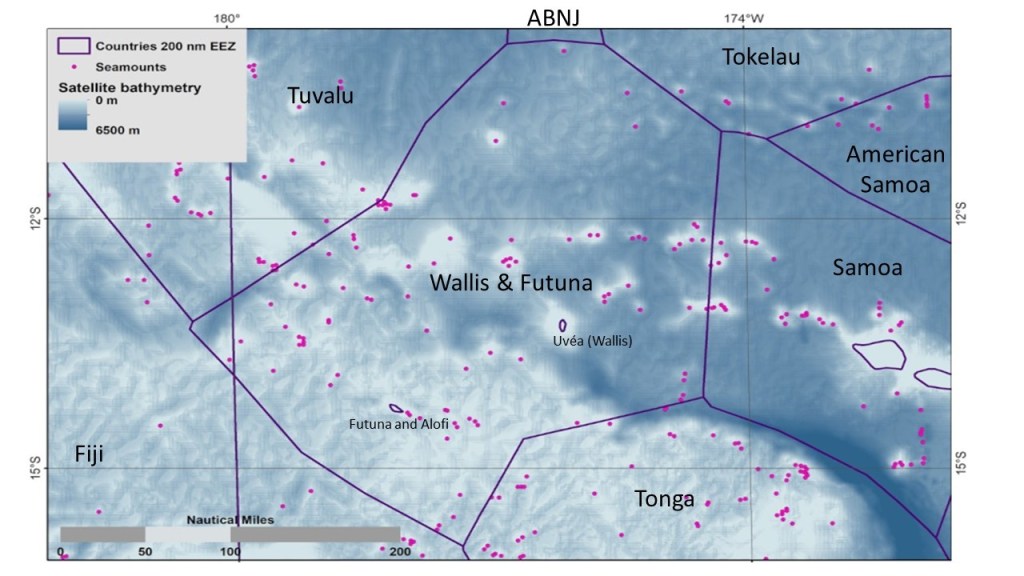
50-year moratorium on deep sea mining in Wallis & Futuna

Map of Wallis & Futuna. © Conservation International

Recognizing the bold commitment made by the Territorial Assembly of French territory Wallis et Futuna (led by President David Vergé) who passed a bill calling for France to conserve 100% of their maritime zone (265,000 square km) as a protected area for sustainable natural resource management. The move also called for the establishment of a 50-year moratorium on deep-sea mining. Most of the territory’s marine realm is formally classified as Ecologically and Biologically Significant under the Convention on Biological Diversity (CBD), featuring a wide range of charismatic species.

Mt. Panie New Caledonia, the largest cloud forest in the Pacific

Mount Panie in New Caledonia. Photo by Conservation International.

I went to New Caledonia this week to see Mt. Panie reserves and other Conservation International’s initiatives in the country. The mountain is the highest mountain in New Caledonia (1,629 m), providing ecosystem and cultural services, home to three-quarter of plant species, and 95% reptile species are found nowhere else!

Our team has been working to conserve the Mt. Panie since 1996 and now supporting the expansion from 5,400 ha to 20,000 ha, to enabling this critical ecosystem to mitigate climate change impact. This forest also important to the continued flow of pristine rivers and the conservation of the downstream mangroves, coral reef and lagoons with its manta rays, turtles and whales.

UNESCO World Heritage List: Lagoons of New Caledonia

Ilot Mato Lagoon Island, South Lagoon Wilderness Area New Caledonia. Photo by newcaledonialagoon.com

New Caledonia’s lagoons cover a total surface area of around 24,000 km². It is home to an exceptional diversity of plant and wildlife. The famous lagoons are a UNESCO World Heritage Site. They provide fish, coastal protection, and hold vast ecotourism potential.

In 2014, New Caledonia created 1.3 million km2 Natural Park of the Coral Sea (an area greater than twice the size of France). It marked a historic moment in marine conservation and is the first contribution to the Pacific Oceanscape by French overseas territory. Given high values for this area to sustains, an integrated approach to manage this Natural Park is important for the wellbeing of the people.

To see more references about Lagoons of New Caledonia (photos, video, map), visit UNESCO World Heritage Convention site.